Grammar
The rules below are not borrowed from Sanskrit and imposed on the signs. They were found by counting — how often each sign stands before or after each other sign, at the start or end of a text, at each site — and each is stated so that anyone can count it again. A rule holds at 90% or more where it applies; a tendency is significant but lower.
The texts are about four thousand years old, older than the Ṛgveda in its fixed form and far older than Pāṇini, so the rules describe a living usage, not a textbook. Poets bend them; the rules say how far.
Taken together: applying every mechanically checkable rule to the whole corpus, 634 objects fall under at least one rule, and 601 of them (94.8%) break none.
Rule 1 · Numbers come first
A number stands before the thing it counts — 90.5% of 1,432 numbers.
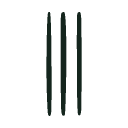

tri-śakti — “three spears”, threefold power
Rule 2 · The head comes last
In a two-sign word the main word — the head — stands second, and the sign before it describes it: mīnā · śakti, “fish-power”, the goddess. This is the order of Sanskrit compounds (rāja-putra, deva-dāsa) and of Hindi and Marathi today.

mīnā-śakti — the goddess Mīnā
Rule 3 · Words join, two or three deep — never four
Signs that belong together form one word (samāsa). A compound is two or three elements deep, never more, and at most one element comes from a family of variant forms. Of 15 registered compounds, 13 are two deep, 2 are three deep, none is four.
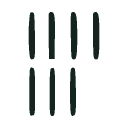


sapta-yajña-pati — “lord of the seven sacrifices”: number · root · title, three deep
The seven-stroke numeral stands before the fire-altar sign in 18 of its 42 uses, 114 times more often than chance; the whole title recurs in 13 texts at Harappa, Mohenjo-daro and Kalibangan. yajña-pati is a word of the Ṛgveda.
The same depth is found inside a single sign: 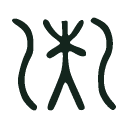 antar-nadī-paśupati, “Paśupati between the rivers”,
draws the god between two flowing lines — frame, river, figure: three deep.
antar-nadī-paśupati, “Paśupati between the rivers”,
draws the god between two flowing lines — frame, river, figure: three deep.
Rule 4 · “Of”: one linker, never at the edge
The sign 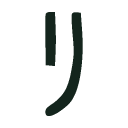 (IS1060, shaped like an elephant's trunk) means “of” (-sya). It occurs at most once in a
text (99%), never at the first or last position (98%), and it opens a phrase that runs to the end of the text
(90%).
(IS1060, shaped like an elephant's trunk) means “of” (-sya). It occurs at most once in a
text (99%), never at the first or last position (98%), and it opens a phrase that runs to the end of the text
(90%).


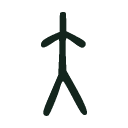
cakra-sya · kūrma, pati manuṣya — “of the cycle, the turtle — lord of man”
In K-16 the scribe broke the line exactly after cakra-sya: the grammar and the layout agree.
Rule 5 · The jar at the end makes a title
The jar is the commonest sign in the script. After a name at the end of a text it is the title
-pati, “lord”; elsewhere it is simply kumbha, the jar. A god's name followed by the jar closes the text as one
word — in 75 of 78 texts (96%).
mīnā-pati — lord of Mīnā
Rule 6 · Bound and between: two frames
A sign drawn inside an enclosure is baddha-, “bound”. A sign drawn between two lines is antar-, “between”. Enclosed signs move to the closing position of the text (58–91% of the time, against 3–9% for the plain sign).
| Plain | Bound | Between |
|---|---|---|
mīnā fish |
 baddha-mīnā bound fish |
antar-nadī-paśupati |
kūrma turtle |
 baddha-kūrma bound turtle |
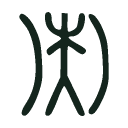 antar-candra-paśupati |
Rule 7 · One sign, noun or verb
A sign can name a thing or an action. What follows decides: in the verb use an object follows the sign.
The rope  is the rope, and ut-kal, “unties”: a vessel follows it in 29 of 55 uses, and stands before it
in only 3. The balance
is the rope, and ut-kal, “unties”: a vessel follows it in 29 of 55 uses, and stands before it
in only 3. The balance  is the balance, and tulayati, “weighs”: 44 after, 5 before, against a 23%
baseline for any sign.
is the balance, and tulayati, “weighs”: 44 after, 5 before, against a 23%
baseline for any sign.

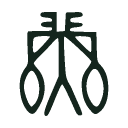

granthi · ut-kal · kumbha-kāra-pāla · sītā
“unties the knot — the potters' overseer — Sītā”
The knot stands directly before the rope in 42 of the rope's 55 uses.
Rule 8 · Things placed before the god
In religious texts the offerings come in a fixed order: turtle → lamp → god-and-title. The lamp stands before the god in 70 of 72 texts, the turtle before the lamp in 9 of 9, and the full order holds in 56 of 58 texts (97%).

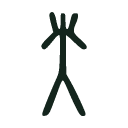
kūrma · pañca-dīpa · paśupati-pati — turtle · five-wick lamp · Paśupati, lord
Rule 9 · One god, one name per text
The god has several names — paśupati, mīnā-pati, triśūla-pati. They almost never meet in one text: 2 texts where 12.5 would be expected by chance. Each text names the god once, under one name — as a hymn chooses one epithet.

paśupati · mīnā-pati · triśūla-pati
Rule 10 · Poetry bends the rules
Some texts are composed, not merely recorded: M-1091 is framed by two turtles, K-16 is laid out by its phrases, and granthi · ut-kal, “untie the knot”, is an image rather than an inventory. Such texts use free word order within the grammar and are not counted as exceptions. Labels and tallies do not carry metaphor. A script that composes is a script that writes a language.