Culture
What the texts record about life in the Indus cities, topic by topic, each claim with the test behind it.
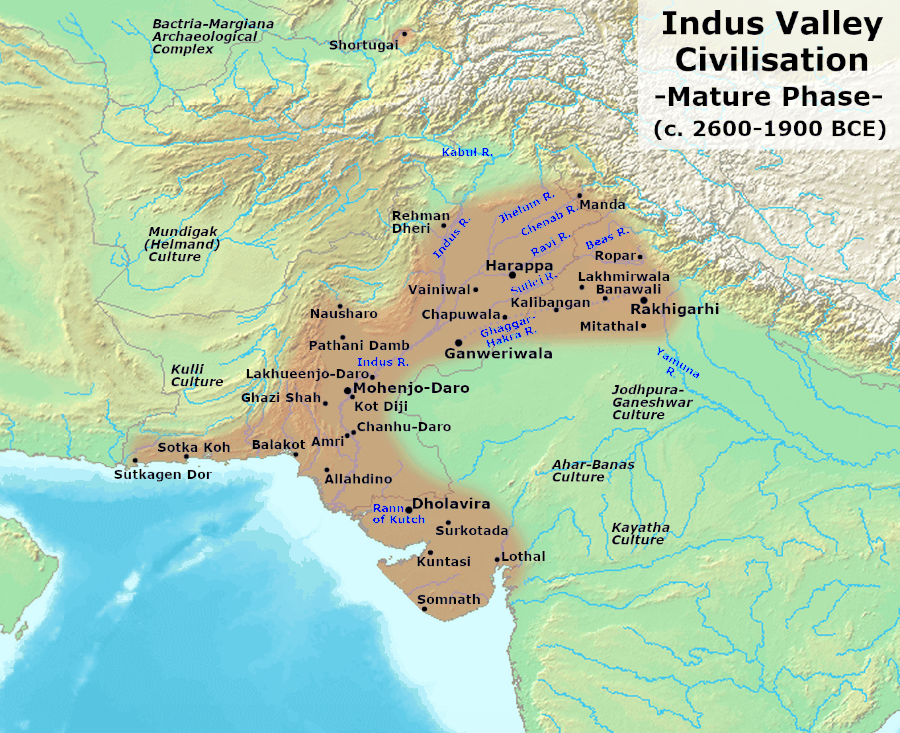
Map: Avantiputra7, after Jane McIntosh, The Ancient Indus Valley: New Perspectives (2008), via Wikimedia Commons, licensed CC BY-SA 3.0. Re-encoded for the web; the map is unchanged.
The places on the map
Sindh: the lower Indus
Mohenjo-daro — The largest city of the civilisation, on the Indus in Sindh, laid out on a grid with covered drains and the Great Bath on its citadel mound. Excavated from 1922, it is a UNESCO World Heritage Site. The Paśupati seal M-304 was found here, and no site gives the corpus more seals. · 1,923 inscribed objects in the corpus — read the texts
Lakhueen-jo-daro — One of the largest Indus cities, over 300 hectares, on the edge of modern Sukkur and about 75 km from Mohenjo-daro. Much of it now lies under an industrial zone. · 15 inscribed objects in the corpus — read the texts
Kot Diji — A fortified town on the east bank of the Indus, across the river from Mohenjo-daro, occupied from about 3300 BCE. It gives its name to the Kot Diji phase, which came before the mature cities. · 11 inscribed objects in the corpus — read the texts
Chanhu-daro — A town about 130 km south of Mohenjo-daro, without a citadel, known as a workshop for carnelian beads and other crafts. Ernest Mackay excavated it in 1935–36. · 74 inscribed objects in the corpus — read the texts
Amri — A settlement south of Mohenjo-daro that reaches back to about 3600 BCE. It is the type site of the Amri culture, an early phase before the cities. · 5 inscribed objects in the corpus — read the texts
Ghazi Shah — A smaller site in the western hills of Sindh, marked on the map west of Mohenjo-daro. · no inscribed object from here in the corpus
Allahdino — A small, unwalled village of about 1.4 hectares, 40 km east of Karachi near the coast. Well planned for its size, it was abandoned by about 2000 BCE. · 12 inscribed objects in the corpus — read the texts
Punjab and the north
Harappa — The first Indus city to be excavated, in 1920–21, on an old course of the Ravi in Punjab; the civilisation is also called Harappan after it. Its mounds hold walled sectors, large public buildings and cemeteries. It gives the corpus more inscribed objects than any other site, above all small tablets. · 2,716 inscribed objects in the corpus — read the texts
Vainiwal — A smaller site in the Punjab plain, marked on the map south-west of Harappa. · no inscribed object from here in the corpus
Rehman Dheri — An early town near Dera Ismail Khan, one of the oldest planned settlements in South Asia, from the phase before the mature cities. · 2 inscribed objects in the corpus — read the texts
Manda — The northernmost Indus site in India, on the Chenab near Jammu. J. P. Joshi excavated it in 1976–77. · no inscribed object from here in the corpus
Ropar — A site on the Sutlej where it leaves the Siwalik hills, in Indian Punjab: the first Harappan site excavated after Independence, in the 1950s. · 5 inscribed objects in the corpus — read the texts
The Ghaggar-Hakra: Cholistan, Rajasthan and Haryana
Ganweriwala — One of the largest Indus cities, in the Cholistan desert, roughly halfway between Harappa and Mohenjo-daro. Found in the 1970s by M. Rafique Mughal, it has not yet been properly excavated. · 2 inscribed objects in the corpus — read the texts
Chapuwala — A smaller site in the Ghaggar-Hakra belt of Cholistan, marked on the map between Harappa and Kalibangan. · no inscribed object from here in the corpus
Kalibangan — A town on the dry Ghaggar in northern Rajasthan, excavated in the 1960s. Beneath the city lies a ploughed field with criss-cross furrows, the oldest known in South Asia, and the town has rows of fire altars. · 212 inscribed objects in the corpus — read the texts
Banawali — A town in Haryana on the dried-up Ghaggar-Hakra, about 120 km north-east of Kalibangan. A terracotta model of a plough found here goes with Kalibangan's ploughed field. · 26 inscribed objects in the corpus — read the texts
Lakhmirwala — A site near the village of Lakhmir Wala, Mansa district, in the Ghaggar basin of Indian Punjab. · no inscribed object from here in the corpus
Rakhigarhi — One of the largest Indus sites, in Haryana about 150 km north-west of Delhi, lived in from the early phase through the mature cities. A burial here gave the first ancient DNA from an Indus person, published in 2019. · 13 inscribed objects in the corpus — read the texts
Mitathal — A site near Bhiwani in Haryana, at the eastern edge of the civilisation. · no inscribed object from here in the corpus
Balochistan and the Makran coast
Nausharo — A town on the Kachi plain of Balochistan, close to Mehrgarh, excavated by a French mission. Its layers show the passage from the earlier village cultures to the mature city. · 38 inscribed objects in the corpus — read the texts
Pathani Damb — A site on the Kachi plain of Balochistan, marked on the map near Nausharo. · no inscribed object from here in the corpus
Balakot — A coastal settlement on the Las Bela plain west of Karachi, excavated by George F. Dales in the 1970s; shell-working was one of its crafts. · 7 inscribed objects in the corpus — read the texts
Sotka Koh — An outpost on the Makran coast about 15 miles north of Pasni, first surveyed by George F. Dales in 1960. · no inscribed object from here in the corpus
Sutkagen Dor — The westernmost known Indus site, on the Makran coast near the Iranian border, beside the Dasht River. A small walled settlement, it probably served the sea trade to the west. · no inscribed object from here in the corpus
Gujarat
Dholavira — A walled city on Khadir island in the Rann of Kutch, known for its stone-cut reservoirs and a 'signboard' of ten large Indus signs found near a gateway. It became a UNESCO World Heritage Site in 2021. · 238 inscribed objects in the corpus — read the texts
Surkotada — A small walled site of about 1.4 hectares in Kutch. · 6 inscribed objects in the corpus — read the texts
Lothal — A town near the head of the Gulf of Khambhat, excavated in the 1950s by S. R. Rao. A large brick basin beside it has been read as a dockyard, and it was a centre of bead-making. · 208 inscribed objects in the corpus — read the texts
Kuntasi — A small port on the Phulki River near Morbi in Saurashtra, now about 5 km inland from the shore. · no inscribed object from here in the corpus
Somnath — Harappan levels lie beneath Prabhas Patan, the town of the later Somnath temple on the Saurashtra coast. · no inscribed object from here in the corpus
Beyond the Indus
Shortugai — A trading colony on the Oxus in northern Afghanistan, set up about 2000 BCE near the lapis lazuli mines; the northernmost Indus settlement. · 1 inscribed object in the corpus — read the texts
The accounts are brief summaries from standard archaeological references. The counts are the inscribed objects in the digitised corpus used throughout this work.